
Response Team Helps Fight Multiple Fires this Month
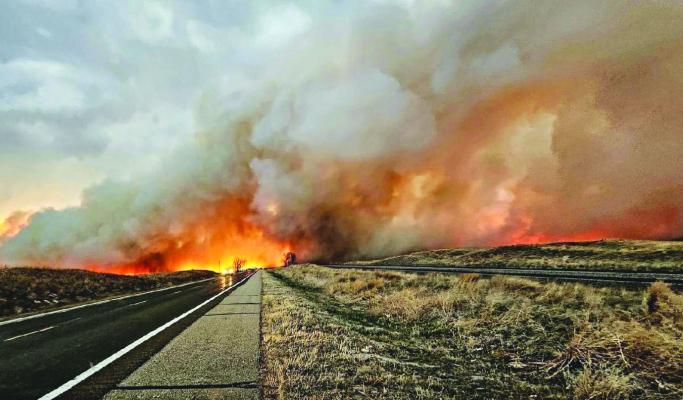
The Platte River Twin Loup Mutual Aid Response Team (Hall-Howard County Strike Team) has been busy this April, having been called to support in fighting fires near Union on Easter Sunday, in fighting the Rock Creek Fire near Fairbury in the early morning hours of Wednesday, April 12th, and in fighting fires near Anselmo on Thursday and Friday, April 13th and 14th, in addition to fighting smaller fires closer to home.
Members of the St. Paul Volunteer Fire, Dannebrog Volunteer Fire, Elba Fire and Rescue, Farwell Volunteer Fire, Grand Island Rural Fire, Cairo Volunteer Fire, Wood River Fire and Rescue, Chapman Volunteer Fire and Rescue, Doniphan Fire and QRT, and Phillips Fire and Rescue departments had responded to at least one of incidents as part of the team.
On Sunday, April 9th, firefighters from more that thirty-seven different Nebraska departments had responded to Union, in Cass County, after strong winds caused a spark from an Iowa brush fire to find its way across the Missouri River on the preceding Saturday afternoon. That brush fire burned an estimated 697 acres in the vicinities of Waconda Lake and Beaver Lake, requiring some residents to evacuate their homes.
“The fire there consisted primarily of trees and grassland along the river,” noted Dannebrog Fire Chief Terry Webb, who co-heads the Howard County side of the mutual aid team alongside St. Paul Fire Assistant Chief Mark Wilson, on Monday. “It was very rough terrain, very difficult to fight.
“To that particular fire, we took five Type Six pumper rigs and one tactical tender, a truck that carries water but can also fight fire,” he noted. (A Type Six engine is essentially a pickup with a tank, hose, and storage in the bed.) “We had left Wood River at 11:00 a.m. on Easter morning, and we got back home at about 6:00 p.m. on Monday.”
Arriving on the scene of the fire on Sunday afternoon, a team of between ten and twelve firemen from the local response team had fought the fire until about midnight Sunday evening, getting a few hours rest at a “civic center, where the Red Cross had cots set up,” before heading out to combat the blaze once again at 6:00 a.m. on Monday.
By the time the local crews had left for home Monday afternoon, said Webb, the fire had been about eighty-five percent contained.
A few days later, another large fire occurred, this one in Jefferson County.
On April 11th, the Fairbury Journal-News had reported that “a rekindled fire from yesterday” had been spreading quickly in the vicinity of Rock Creek Station State Historical Park, about nine miles east of Fairbury and three miles northeast of Endicott, bolstered by strong southerly winds.
Jefferson and Saline County Emergency Management (JSEM) estimated later that day— with the fire largely contained—that the Rock Creek Fire had burned an estimated 2,600 acres near Endicott and Rock Creek Station State Historical Park, calling it “one of the largest wildfires in years” in Jefferson County.
“Numerous homes have been threatened, along with Rock Creek Historical Park buildings,” noted JSEM on social media last Tuesday.
Drone observation by the Nebraska State Patrol last Friday would later reduce the estimated burned acres to 1,800.
Seven departments composing the local Platte River Twin Loup Mutual Aid Response Team were among a total of twelve departments across the state to respond to the Jefferson County blaze. The Nebraska State Fire Marshal’s Office’s Wildland Incident Response and Assistance Team had helped coordinate the response.
While Webb had not responded to that fire, he noted that the taskforce had once again sent about ten to twelve responders in five Type Six trucks and one tactical tender to aid in the response.
“We always try to send five Type Six trucks and one tactical tender, and that’s what we ended up sending up there as well… and we try to man each truck with two people,” he said. “They left here at 3:00 in the morning and got back here at about 11:00 p.m.”
That fire was ninety percent contained as of last Friday morning.
Then, beginning last Thursday night, a fire in Custer County burned across the rural Anselmo, Dunning, Milburn area, blazing as far north as the Middle Loup River. Merna and Anselmo fire departments first responded to the call Thursday afternoon, later calling for mutual aid from the Broken Bow, Sargent, Brewster, and Arnold fire departments. Later that evening and on Friday morning, amid a severe thunderstorm warning, several firefighters from the local mutual aid response team—including firemen from Dannebrog and Elba—responded to the blaze. Lightning preponderated throughout the area, bringing with it little rain and strong winds that carried sparks across the prairie, kindling seven additional fires.
“Anywhere the wind would take a spark, another fire would ignite,” noted the Merna Volunteer Fire Department on social media on Friday.
“Custer County are the ones who called us,” noted Webb. “That was Thursday the 13th; we were notified at about 7:00 [p.m.] and we were on the road by 7:45…We returned Friday, the 14th, at about [6:00 p.m.].”
Once again, a crew of ten-to-twelve people, five Type Six trucks, and one tender were sent off in response to the call.
“The initial fire that we were responding to had been caused [by a spark from a] train track, well, train,” said Webb. “Before we got there, we got a call in route saying that lightning strikes had started another pretty good-sized fire “We had high winds and difficulty gaining access to the areas; the wind was the biggest issue.
“Basically, we worked the whole time until it was time for us to come home,” said Webb. “During Friday afternoon, that entailed basically just monitoring; the fires were pretty much out. We went in shifts, with a truck taking like two-hour naps or so while others monitored everything.”
During both the Union and the Custer County fires, noted Webb, “high winds and dry conditions really played a role.”
As of last Friday, with all of the remaining Custer County fires eighty-five percent contained, the blazes were estimated to have burned between 100,000 and 120,000 acres; structures, hay, and, possibly, livestock were lost.
Due to the size of the fire, noted Custer County Emergency Management Director Mark Rempe in a Nebraska Emergency Management Agency (NEMA) press release last Friday, “assessment on all the damage is just beginning.
“We are thankful there was no loss of life. A large number of fire departments, aircraft, and volunteers assisted, but an official count is not yet available.”
According to NEMA, in addition to Custer County and Jefferson County, wildfires had been reported last week in Cherry, Douglas, Lancaster, Rock, Wheeler, Hall, Wayne, Stanton, and Thurston counties due to the dry and windy conditions around the state.
In the past week— between the Anselmo and Rock Creek fires, as well as local fires—the Platte River Twin Loup Mutual Aid Response Team has been called out “five of the past seven days.”
Grass fires in Dannebrog and Boelus areas, Webb said, have kept his department busy at home this month, most notably a controlled burn that “got out of control” on April 1st and burned about seventy-five to eighty acres in the area.
“Pretty much the whole county, and Grand Island Rural, was involved in that one,” he said.
This April, according to the U.S. Drought Monitor, virtually all of Nebraska— excepting a portion of southeastern Richardson County—is facing some level of drought.
Nearly all of Howard County is in “Severe Drought” (D3), with a sliver of the southeastern portion of the county facing “Extreme Drought” (D4) conditions.
In response to the ongoing fires and drought, Nebraska Governor Jim Pillen had signed a proclamation declaring a State of Emergency in Nebraska and prohibited burns statewide by executive order; that order expired on midnight of Sunday, April 16th.
“The state always has a burn ban—you have to obtain a burn permit from your local fire department,” said Webb, “but the governor did issue a mandatory burn ban… meaning even fire chiefs weren’t allowed to issue burn permits.”
On Monday, that mandatory ban was extended through April 23rd. Several fire departments— including St. Paul’s and Dannebrog’s—retain a halt on issuing burn permits.
Webb said that Dannebrog “Is not issuing any burn permits at all” until the weather changes.
Until such a time that the county receives some precipitation, he said his department’s policy will remain “don’t burn, period.”
So far, the Platte River Twin Loup Mutual Aid Response Team has been travelling to aid in large fires abroad, but the prospect of a local fire, Webb said, was “always a possibility.
“Anytime it’s this dry, with this much wind, the county has the potential [for fires]. That’s why we only take, at most, one truck and maybe two personnel from each department [as part of a strike force response], so that we don’t leave our county without firefighting capability.
“And, whenever the strike force leaves the county, we go to a countywide page, so that, for any type of fire at all, the whole county will be turning up simultaneously, to make sure there’s enough personnel to cover it.
“When the strike team goes out, our county is very well-protected,” he stressed.
Those from Howard County looking to help support the Platte River Twin Loup Mutual Aid Response Team with a financial donation or much-needed supplies, said Webb, can reach out to him or Mark Wilson.