
VOTERS TO WEIGH CPS BOND
Centura district proposes $18.95 million bond to voters
In under two weeks, stakeholders in the Centura School District will decide the future of a number of proposed updates to the home of the Burgundy and Gray.
A bond question on the May 12th primary ballot will let district taxpayers approve or reject the issuance of up to $18,950,000 in bonds to help pay for the costs of approximately 49,951 square feet of additions and renovations to Centura Public Schools (CPS).
“We have really tried to reallocate and use the space we have had,” said Centura Superintendent Dr. Kaela Heneger of the project. “What we’re renovating and what we’re adding on it are about equal.”
Heneger spoke to the Phonograph- Herald about the project alongside Centura Public Schools Board of Education Treasurer Todd Nitsch and community stakeholder, steering committee member, and Centura graduate Ryan Hanousek earlier this week.
Much of the CPS campus is original to its initial 1969 construction. The proposed bond issue would be the first for the district since major capital improvements in 1981.
According to the district representatives, much-needed “safety, security, and mechanical updates” would comprise much of the undertaking’s almost nineteen-million-dollar budget. About forty-two percent of the budget is earmarked for mechanical, electrical, and plumbing (MEP) systems updates and life safety improvements—things that “you will barely see, but which are definitely needed,” per Nitsch.
“We’ve replaced parts of the HVAC system over the years, but the majority of it is still original to the 1969 and 1981 buildings,” Heneger noted for example. “Then we have fire safety controls and the sprinkler system.”
According to the administrator, “most of the building” does not have a sprinkler system; the parts for much of the system are old and no longer in construction.
“When we worked with [the Centura Educational Foundation] in 2018 to update the science rooms, those rooms got sprinkler systems, but not everything else did,” she said. “The manufacturer doesn’t make parts for the sprinkler and the fire system anymore, so we’ve had to use different sources to find and buy them, including eBay.”
A further thirty-fourpercent of the projected budget is designated for entryway improvements designed to improve the security at the school.
“When you walk in the building currently,” noted the superintendent, “you have to be buzzed in, but you walk right in to the building. There’s nobody there to greet you. You have to go down and around…Somebody is able to walk in after they have buzzed in and go anywhere they want.”
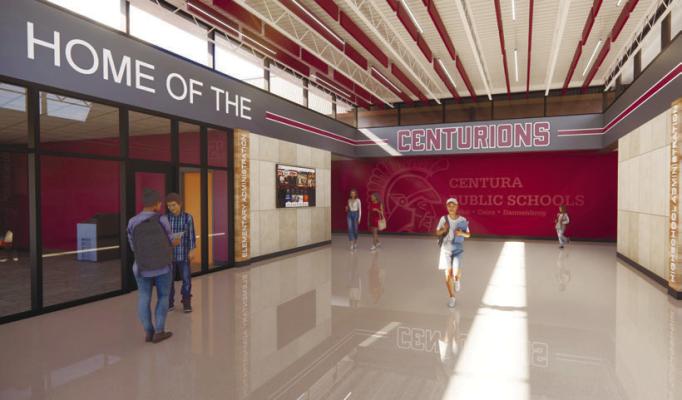
Currently, the front doors open directly into a foyer, from which a visitor must consciously bear right and walk towards a commons area to sign in at the office. The renovations would place the high school and elementary offices at the entrances, allowing the district to more securely sign visitors in.
The roughly twenty- four percent of the budget remaining would go towards additions and renovations aimed at further security and efficiency—particularly changes to the cafeteria, locker rooms, classroom additions and repurposing, and site work.
“A lot of the rest of the budget is dealing with reallocation of space,” said Nitsch, “being able to get our kids in the right places for the best possible learning experience they can have.
“A lot of the space that is ‘addition’ will be allocated from a spot that is existing.”
Among these space reallocations is “getting our health area in a different spot, and our weight room into that space—versus upstairs, where it currently is,” Nitsch said. “That was, at one point, the wrestling deck, and our kids are traveling to other places off campus today to be able to have wrestling practice.”
About 25,287 square feet of the project is expected to be new construction; about 24,664 is expected to be renovated.
By building the entry addition and moving the current offices closer towards the entrance, noted Heneger, the district hopes to be able to “open up the cafeteria and commons area,” giving students much more space for lunch and other activities.
“Doing this will make it so we don’t have to start lunch at 10:50,” she noted. “We will be able to sit more students in the actual cafeteria.
“Right now, our elementary kids start lunch at 10:50 a.m. and we don’t wrap up with high school until 1:15 p.m.”
With the age of the building comes a number of concerns regarding Americans with Disabilities Act (ADA) compliance, as well as space for the many activities and supports present in the school. The remodeling work is expected to solve these issues while making access more efficient.
“We are looking to free up some spaces for programming that we have now that we didn’t before,” noted Heneger.
“When the building was built, we didn’t have the number of special education staff that we have now. We didn’t have interventions that are needed. Things that are required now were not in place,” she noted. “There are occupational therapists, there are physical therapists, there are special education teachers, speech language pathologists…All of those different pieces weren’t in the plan when the school was originally built.”
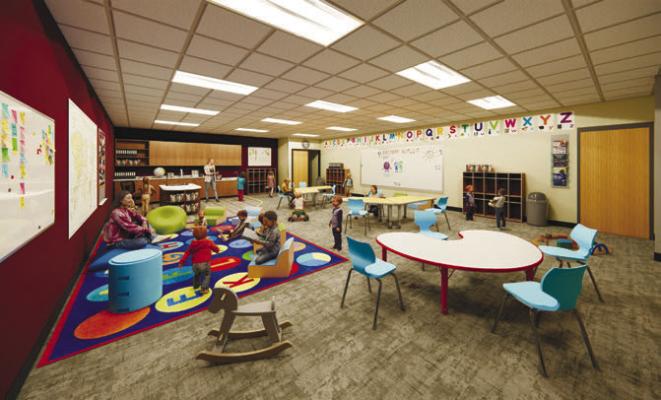
By moving the school’s two preschool classrooms, the district hopes to allocate these resources sufficient space in a “multi-purpose room.”
The process that led to the bond issue vote, the superintendent said, began in 2022 with exploratory discussions with Wilkins Architecture Design Planning, LLC—and others— about the district’s facility needs.
“They did a complete audit on the facilities and started planning at that point and time,” said Heneger.
Those findings became the cornerstone for district administrators and representatives when they formed a steering committee and began soliciting opinions from the public.
“It ramped up here in July [2025], when we started looking at actual needs and what some of those solutions would be,” she noted.
Through “more than six” steering committee meetings, a number of tours, surveys, and countless conversations in person and online with the public, the maximum $18,950,000 bond issue was arrived at, aimed at managing priority needs expressed by educators, students, and stakeholders while keeping expenses down.
“A lot of tough conversations were had at those [steering committee] meetings to come to those numbers,” Hanousek noted. “We cut a lot of stuff off…because we didn’t think it was feasible to ask for budgetarily wise.”
“There was a hierarchy of things that kept coming to the top,” noted Nitsch. “Through work with BD Construction and the other partners we have worked with to this point…the priority list [making up the current bond budget breakdown] came into place.”
CPS is contracting through the construction manager at risk (CMAR) delivery method, in which the contractor is brought in early to help plan the project and then commits to building it for a set maximum price. The $18,950,000 bond issue is not a fixed number, but rather a maximum limit.
Should the bond issue pass, CPS would go through “probably about a three-month process” of finalizing the construction manager and project plans before soliciting bids for various portions of the work.
“The bond is up to $18.95. That doesn’t guarantee that that is what we are spending,” Heneger stressed. “That is what we are authorized to bond to…We cannot go one cent over that.”
The bond issue, if issued in full, is projected— based on current valuations and financing assumptions—to increase the district’s annual property tax request by $1,143,578, from $6,628,644 to $7,772,222. However, the district, Heneger noted, may potentially issue bonds in multiple phases and refinance debt, if needed.
The currently available models and renderings depict a hypothetical project: What the undertaking might look like if the district were to proceed with the full scope at once under current market conditions.
With inflation being what it is and restrictions on levies being what they are, Hanousek said, trying to save to pay for such a project without bonding would likely not be feasible.
“You might be saving for ten years, and then when inflation kicks in, you still can’t do the project,” he said.
While CPS has saved up funds in its Special Building Fund over the last several years, those monies are largely currently earmarked for updates to the wastewater treatment plant. That seperate undertaking is “not part of the bond at all,” noted Heneger.
“Our certificate for the wastewater treatment plant will not be in compliance in 2027, so we have to do something different with that,” she said.
Hanousek called the building updates proposed via the bond issue “purposeful,” “respectful” to stakeholders, and “urgent,” in that they largely deal with systems integral to the operations of the school. While noting that “there’s never a right time for your taxes to increase,” he stressed that, as a local farmer and taxpayer, he saw the bond issue as the most viable means of being prudent with taxpayer money long-term.
“If a system were to go down during the school year, what would be the solution?” he asked. “The best solution is to pick a system to serve the building long-term, not to just try to put a Band-Aide fix on things when they break during the school year.
“Why keep fixing a 300,000-mile car? There comes a point of diminishing returns on everything.”
“These things have been building…[and] there comes a point in time where we have to address them,” Nitsch concurred. “We have definitely tried to remain fiscally responsible, trying to address the needs we really have.”
The school board member said he felt that the 2026 primary was the best time for the bond issue, “even with the economic times that we have today.” The alternatives, he said, amounted to kicking the can down the road.
“This building is still aging, and it will continue to age,” he said. “I feel like we have the opportunity to bond now and address these larger items that are of need and spread that cost out over time…If something were to happen in a major way, we’d be looking at some more urgent type of financing to cover those costs.
“Things become more expensive every year, and if we keep piecing things together, we could end up in a spot where it is going to cost more.”
Should the bond issue fail at the ballot box, CPS would not be able to go back out for bond until 2027. The administration and the board of education, Heneger noted, would have to “have some really hard conversations” on how to move forward fiscally.
“It would be piecemealed together…Over time, it will cost us more,” she claimed, “and it will become reactionary, instead of proactive.”
Heneger said that she was aware the bond was “a big ask,” but reiterated that she felt it was the most prudent way forward for the district.
“We want to be purposeful and respectful and to do this well,” she said. “We hope to get ourselves into a neutral area, so that we can start planning for the future and we don’t have to do this again.
“We hope that we have given everybody an opportunity to ask their questions and get the information they need. If they do still have questions, they can reach out.”
Hanousek agreed. “It is a huge ask, but we have a mountain we have to climb so we can see what’s over the next hill,” he said. “It’s never the right time for a bond, but we have to climb the mountain sometime, and I don’t think we can save our way to the top.”
The district will continue to offer tours in rolling blocks up to the primary, including on May 1st and 7th, from 1:00 p.m. until 6:00 p.m.