
New program quickly takes root at St. Paul Library
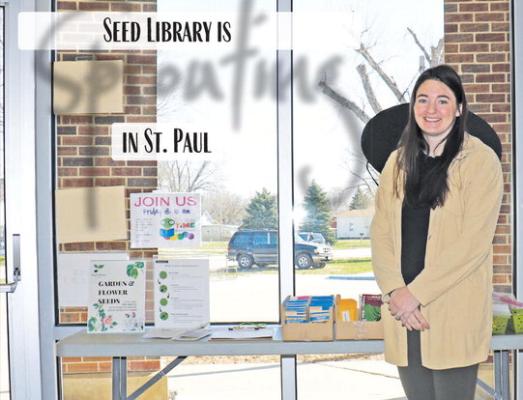
The state of Nebraska may be severely wanting for April showers, but that hasn’t stopped St. Paul Community Library Interim Director Kelli Helton from trying to help community members cultivate some May flowers.
On Thursday, March 30th, the St. Paul Community Library had inaugurated the St. Paul Seed Library, which allows library card holders the opportunity to “check out” seeds from the local library’s stores predicated on the promise that they bring seeds back to the library to replenish its seed bank this fall.
Helton said in an interview on April 10th that two things had inspired the creation of the seed library this year: the announcement of the creation of a community garden by the Rotary Club of St Paul, Nebraska (Rotarians had worked to construct the fence for that project last Friday), and the preponderance of seed libraries in other local libraries—in communities like Grand Island and Ravenna.
“I happened to see that the rotary club was doing a community garden, and I thought, ‘Oh, that’s cool,’ and then…I saw that Grand Island’s library was doing a seed library. So, then, of course, I thought I had to do a seed library, because it works with the community garden and I just thought it was a great idea.
“I thought, ‘What better resource to offer to our community?’” Having resolved to bring a seed library to St. Paul, Helton then reached out to the Grand Island library to ask them a bit about the ins-and-outs of their own program.
A seed library, noted Helton, is a store of seeds from which individuals can “check out” seed in order to plant and grow their own food, herbs, and flowers. Its function, she said, is not altogether different from how the library itself functions. Those with library cards are welcome to come and borrow up to five packets of seeds in a given visit to the library, with the conditions of that borrowing being that they allow a few plants to seed and, at the end of the growing season, return at least a portion of the seeds from the checked-out plants back to the library.
With a sense of how Grand Island ran their seed library program, Helton said her next step had been soliciting seed donations for the program’s inaugural year.
“The next thing was getting donations,” she said. “I just called some people and was able to get some donations. I kind of made a little brochure of how a seed library works and the basic rules, and that was kind of it.
“I got donations, and I set it up.”
The turnaround time from having the idea to getting the seed library started, Helton said, had been “pretty fast.
“It was probably less than a month, I feel like.”
At least for the time being, the seed library is set up in the library’s entryway off of Howard Avenue, with packets of seeds and a sign-up sheet sitting out for any library member interested in trying out their green thumb this year.
“Each visit to the library, you are welcome to take up to five packets of seeds. To check out the seeds, you just write down your name on my clipboard, and how many packets you took that day, and then the seeds are free to take.
“Then, you get to grow your seeds. And the hope is that most people will remember to save their seeds after everything comes to maturity, that they’ll gather their seeds and bring [the seeds] back in so we can start the process over again next year.
“Right now, I just kind of have them in some boxes; there’s a lot that are in Ziplock baggies that [donors] had collected at home,” she noted. “Hopefully, I will get things more organized as time goes on.”
In its first year, noted the interim library director, the local seed library contains “a lot of flowers,” but she hopes the program will grow to include more herbs and vegetables.
“Right now, I have a lot of flowers,” she said. “It’s mostly flowers. But one of the wonderful volunteers at Grand Island’s seed library brought me a bunch of beans and sugarsnap peas; I have some pumpkins, eggplants, and beets. So, there’s an odd variety of things as well, but mostly flowers.
“I’m hoping that we can get some vegetables and herbs maybe started as well.”
The library, she noted, is always looking for donations that could help its seed library grow.
“If anybody has seeds from last year’s garden that they’d like to donate, they are welcome to bring them in,” she said.
By April 10th—under two weeks since the program’s inception— twenty-two people had already come to the library to check out seeds, which Helton felt was a testament to local interest in the project. On week later, by April 17th, a total of fortyone people had checked out 160 packets of seeds.
“I’m actually amazed how well it has done,” said Helton on Monday.
Asked what made the project appealing to her in the first place, Helton said, “Any resource the library can provide is always something we want to do for our community.
“Seeds can be expensive, and I guess I wanted to encourage people to get out and garden, get their hands dirty,” she added. “It’s good for the soul.”
Also important, she said, was sustainability. As plant species evolve through generations, each subsequent generation develops adaptations to the differing environmental conditions, creating biodiversity, which helps maintain the health of the plants.
“When you’re saving seeds like this for years and years on end, you’re going to continue to get more well-adapted crops,” she said. “And the seeds you get from Wal-Mart might not be the best adapted for this soil.”